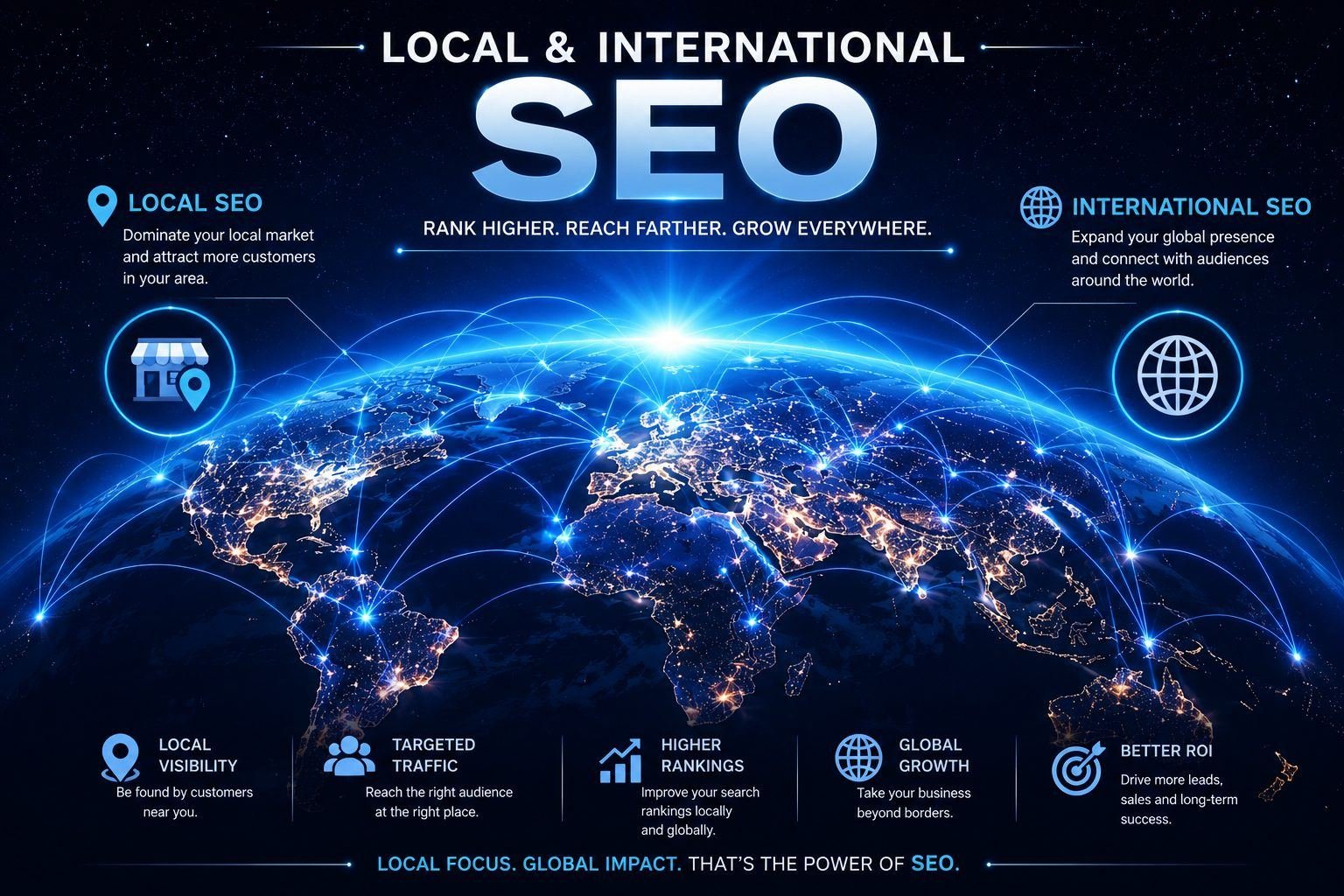
Local & International SEO: How Businesses Can Grow Their Online Presence Globally
In today's digital world, having an online presence is not enough. Businesses need to make sure their websites appear in front of the right audience at the right time. This is where SEO (Search Engine Optimization) plays an important role. Whether a business wants to attract customers from a specific city or expand into international markets, SEO helps improve visibility, increase website traffic, and generate better growth opportunities.
Local SEO and International SEO are two different strategies that focus on different audiences. Local SEO helps businesses connect with nearby customers, while International SEO helps brands reach users across different countries and languages. Understanding the difference between these strategies allows businesses to create a stronger online marketing plan.
What Is Local SEO?
Local SEO is the process of optimizing a website to improve visibility in local search results. It is mainly used by businesses that provide services or products within a specific geographic area. For example, restaurants, medical clinics, repair services, law firms, and local stores depend heavily on local SEO to attract nearby customers.
When users search for services like “best coffee shop near me” or “AC repair in New York,” search engines use location-based signals to show relevant businesses. Optimizing a Google Business Profile, collecting customer reviews, creating location-specific pages, and maintaining accurate business information are important parts of a successful local SEO strategy.
Local SEO helps businesses increase phone calls, store visits, and customer inquiries. A well-optimized local presence builds trust because customers can easily find important information such as address, working hours, reviews, and services.
Importance of Google Business Profile in Local SEO
One of the most important elements of local SEO is a properly optimized Google Business Profile. This profile allows businesses to appear in Google Maps and local search results.
Businesses should keep their information updated, including business name, address, phone number, categories, photos, and service details. Regularly adding posts and responding to customer reviews can also improve engagement and build credibility.
Customer reviews are another powerful ranking factor. Positive reviews not only improve local rankings but also influence potential customers when they are deciding which business to choose.
What Is International SEO?
International SEO focuses on improving a website's visibility across multiple countries and regions. It is designed for businesses that want to target customers outside their home market.
Unlike local SEO, international SEO requires a deeper understanding of different audiences, languages, cultures, and search behaviors. A website targeting users in different countries must be optimized according to their specific needs.
For example, a company selling products in the United States, United Kingdom, and Germany may need separate content strategies for each market. This can include language-specific pages, international keyword research, currency adjustments, and location-based content.
Key Elements of International SEO
Successful international SEO requires careful planning. One important factor is website structure. Businesses can use country-specific domains, subdomains, or subdirectories to organize their international content.
Language optimization is also essential. Simply translating content word-for-word is not enough. Content should be adapted according to local culture and user expectations. This process is known as localization.
Another important factor is hreflang implementation. Hreflang tags help search engines understand which version of a page should be displayed to users based on their language and location.
Difference Between Local and International SEO
Although both strategies aim to improve search visibility, their goals are different. Local SEO focuses on attracting customers within a specific area, while International SEO targets audiences across different countries.
Local SEO depends heavily on location signals, Google Business Profile optimization, and local reviews. International SEO requires global keyword research, multilingual content, technical optimization, and market analysis.
A small local business may only need local SEO to generate leads, while a global company may require a complete international SEO strategy to compete in different markets.
How Businesses Can Use Both Strategies Together
Some businesses can benefit from combining local and international SEO. For example, a company may have offices in multiple cities while also serving customers worldwide.
In such cases, businesses can create location-specific pages for local customers while developing international landing pages for global audiences. This approach allows them to capture different types of search traffic and increase their overall visibility.
A strong SEO strategy should always focus on user experience. Websites should be fast, mobile-friendly, easy to navigate, and provide valuable information that answers customer questions.
Future of Local and International SEO
Search engines continue to become smarter, and SEO is constantly changing. Artificial intelligence, voice search, mobile searches, and personalized results are influencing how businesses optimize their websites.
Companies that focus on quality content, technical SEO, user experience, and trust signals will have better chances of long-term success. Whether targeting a local audience or an international market, businesses need a flexible SEO strategy that adapts to changing search trends.
Conclusion
Local and International SEO both play an important role in digital growth. Local SEO helps businesses connect with nearby customers, while International SEO allows brands to expand their reach globally. Choosing the right approach depends on business goals, target audience, and market requirements.
By investing in proper keyword research, quality content, technical optimization, and customer-focused strategies, businesses can improve their search rankings and build a stronger online presence in both local and international markets.